I’m really intrigued by Islamic geometric patterns, having read the excellent books by Eric Broug and attempted to draw some of them myself. I spotted one particular tiled pattern on the internet that is frequently attributed to the Taj Mahal, so when I visited there in 2023 I kept an eye open for it. However, after several hours I hadn’t managed to find it anywhere.

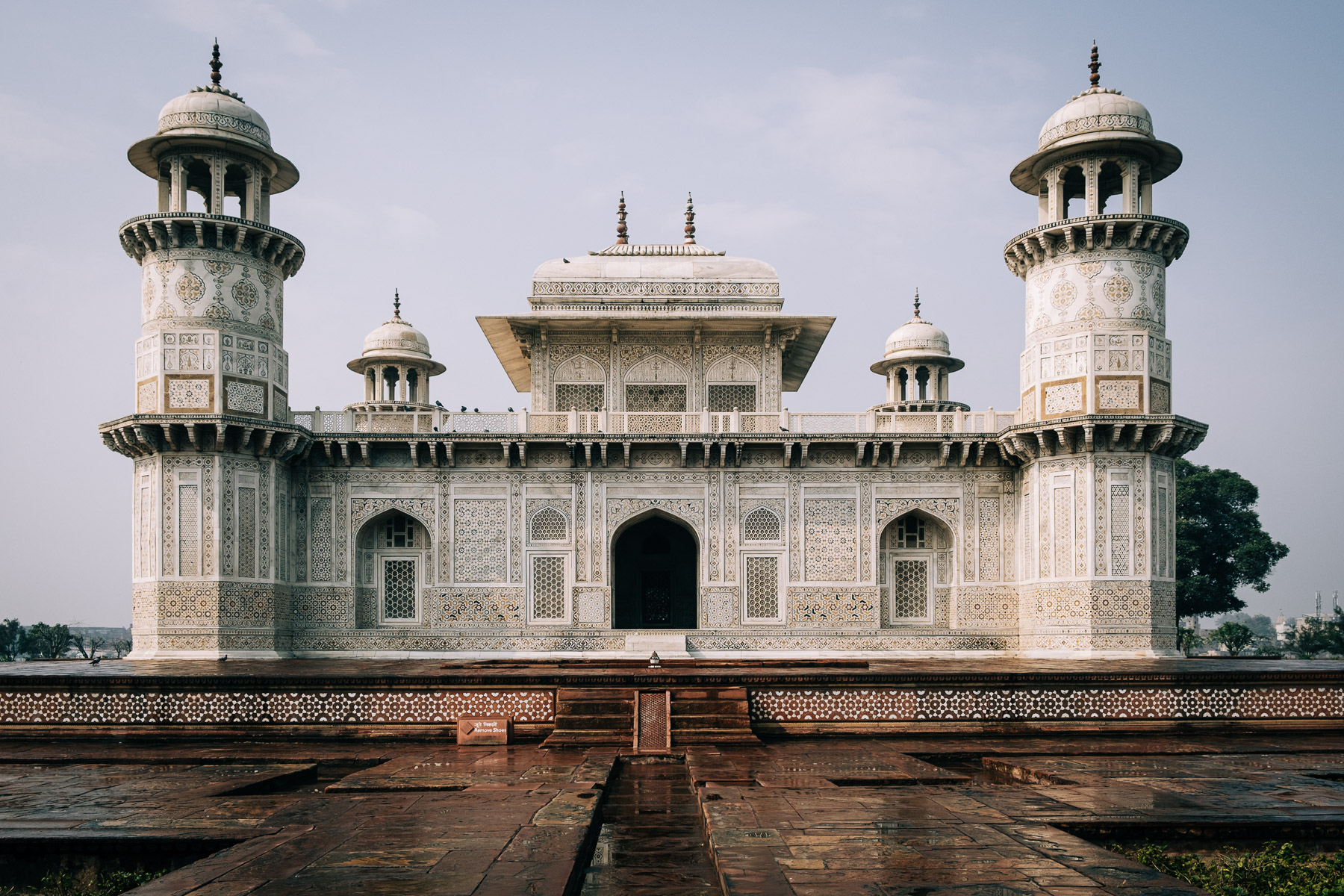
In fact, it wasn’t there at all. It’s a panel on the ornately tiled exterior of the tomb of I’timād-ud-Daulah, sometimes called the “Baby Taj”, which is also in Agra a few kilometers north-west of the Taj Mahal. The tomb was built between 1620 and 1628, and has walls of white marble from Rajhastan inlaid with mosaics and semi-precious stones. The building is often described as a “jewel box” and is considered an architectural stepping-stone between earlier Mughal buildings – which were primarily red sandstone – and the ubiquitous white marble of the Taj Mahal.
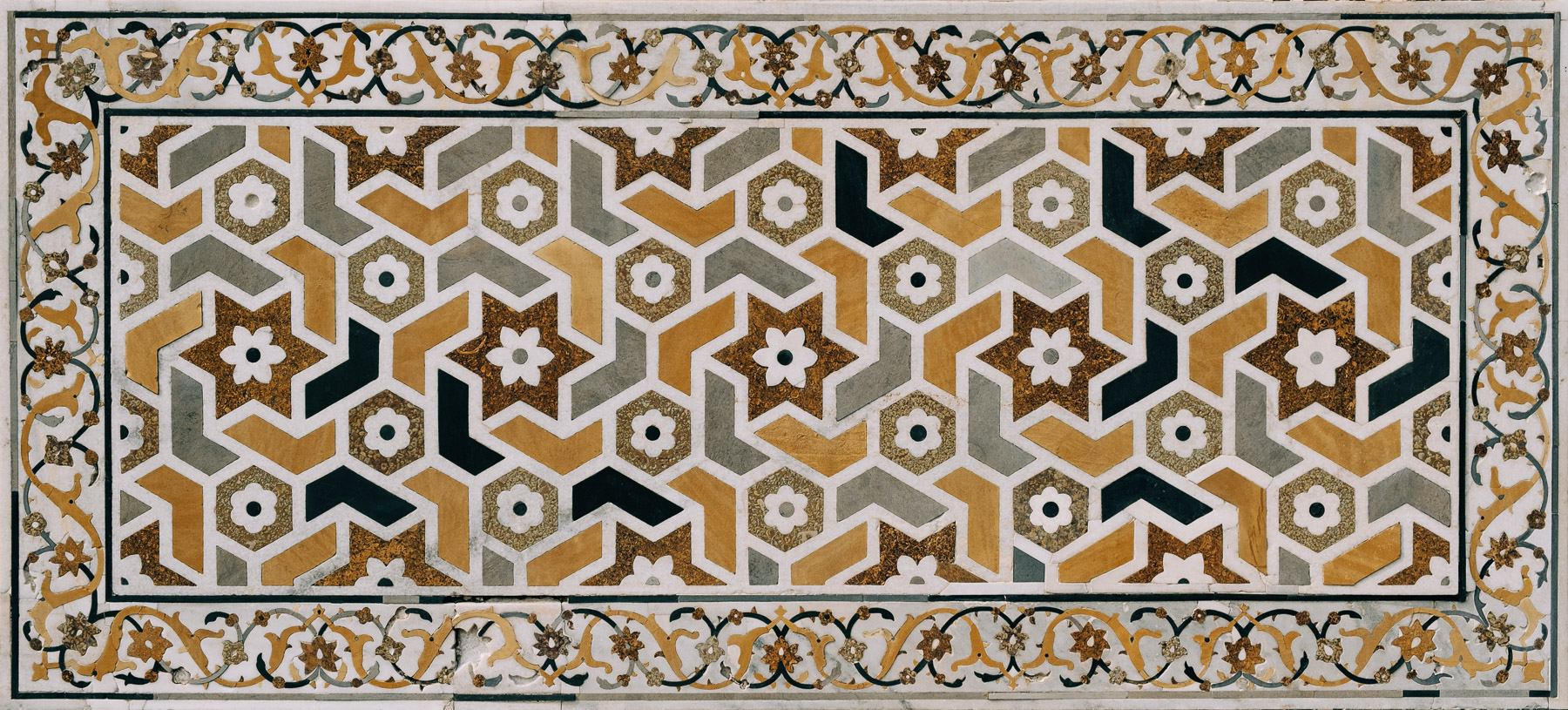
It took me a little while to understand how this pattern could be made from a single repeating tile, since it is apparently composed of a number of repeating and rotated segments. There are three basic shapes, a six-pointed star with a large flower, a hexagon containing a smaller flower, and an L-shaped form which is repeated six times at different rotations. In fact the pattern can be made from a single hexagonal tile, which has the large flower in its centre and sections of a smaller flower at each vertex. The following shows how to construct the tile on a grid:
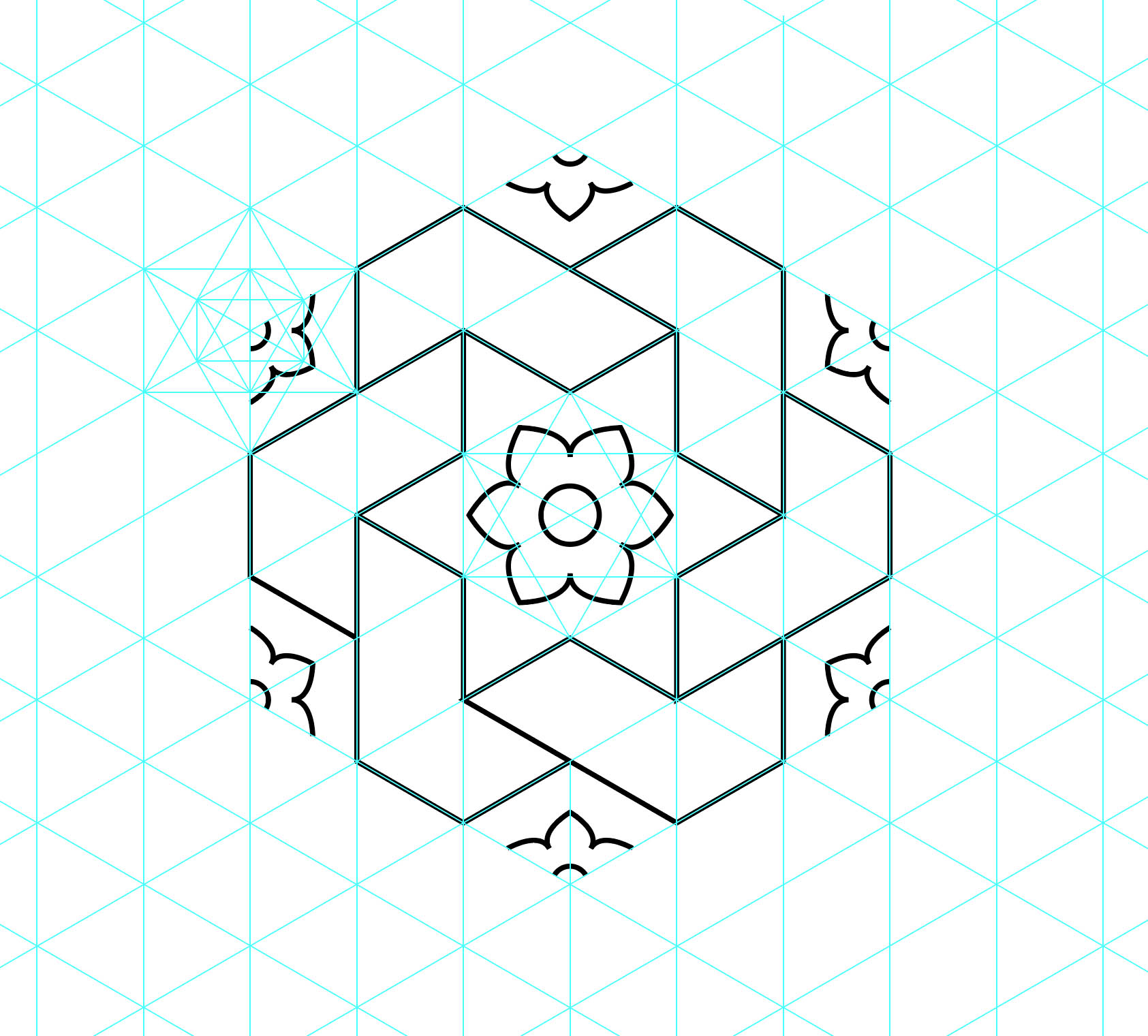
And this is how several tiles fit together to make the pattern:

Here is a coloured version of the tile …

… and the complete pattern.

If you’re interested in playing with this yourself you can download the following Adobe Illustrator file from the link below.
I really do marvel at the ingenuity and skill of the artisans who designed these patterns, and then rendered them so accurately as mosaics on the walls of this great building. Those wanting to know more should definitely check out Eric Broug’s book Islamic Geometric Design (Thames and Hudson, 2013).